One physical interface.
Common mating geometry, attachment points, and clearance rules make the cube recognizable to every compatible carrier.
 DroneCube.io
A FIELD GUIDE TO MODULAR DELIVERY
From factory floor to front door.
A shared package standard for a world
that moves by road, rail, and air.
Different vehicles. Same language.
01 / A SIMPLE STARTING POINT
Today, every handoff has its own rules. DroneCube imagines a modular cargo unit that fits a shared family of docks and carriers. Pack once. Identify once. Transfer between modes without rebuilding the package around the vehicle.
Common mating geometry, attachment points, and clearance rules make the cube recognizable to every compatible carrier.
A shared identity and handoff record connect the destination, cargo requirements, and next step in the journey.
A factory robot, road vehicle, flying carrier, and home dock each do the part of the trip they are suited to.
02 / TRACE THE HANDOFF
Tap a stop.
See what changes. ↙
ORIGIN / PREPARE & VERIFY
A production cell packs the cargo into a compatible cube, checks mass and balance, and assigns a routing identity. A factory dock confirms attachment and custody before releasing the unit.
Illustrative route. Actual modes depend on cargo, range, infrastructure, and operating approval.
03 / THE CONNECTED ECOSYSTEM
Standardize the connection.
Let the vehicles be different.
AIR / FLYING CARRIERS
A removable cargo interface lets a flying vehicle connect to the same unit used on the ground. Carrier design must account for payload, weather, battery reserve, safe landing, and secure retention.
Different airframes. Shared attachment.ORIGIN / FACTORIES
Production cells and depots prepare cubes for travel. Robots load, inspect, sort, and hand off cargo through agreed geometry and machine-readable delivery records.
Pack once. Prepare for every mode.DESTINATION / HOMES
A compatible dock provides a known place to deliver. It verifies the intended recipient, confirms safe placement, and records receipt before a carrier releases the cube.
A verified handoff at the last meter.GROUND / AUTONOMOUS TRANSIT
Road vehicles, rail systems, and local delivery robots move cubes in compatible racks. Grouping cargo on the ground can reserve flight for legs where it adds useful reach.
One journey. Several kinds of carrier.04 / MODULAR DELIVERY & PACKAGE ROUTING STANDARDS
The sketch’s standards idea:
a common language for physical delivery.
Interoperability begins at the handoff. A DroneCube standard would need to define both the physical connection and the information exchanged when cargo changes hands.
Unit size classes, docking surfaces, clearances, attachment locations, and tolerances. Dimensions remain an engineering decision.
Mass limits, balance, environmental needs, and positive locking. Each carrier checks that the cube is inside its supported envelope.
Unique cargo identity, authorized destination, custody history, and mode constraints. Share the information needed for a handoff.
Acknowledge arrival, verify alignment, confirm retention, then release. Record who accepted responsibility at every transfer.
Detect a failed connection, reject an unsafe load, and preserve custody when a route is interrupted. Define human recovery paths.
Reference fixtures, repeatable transfer tests, and published supported profiles. Demonstrate interoperability before claiming it.
MDPRS Labs and IFV Corp are names from the founding sketch. This site presents the concept; it does not establish a published standard, certification program, corporation, or tax status.
05 / THE BIGGER PICTURE
The sketch names an “Intermodal Flying Vehicle Corporation of America.” Its larger idea is a delivery system where air and ground work together, linked by the cube.
A cube is the organizing unit. A carrier is one way to move it. A dock is where responsibility changes hands. Standards let independent builders participate in the same network.
The loop includes returns, reusable packaging, inspection, repair, and the next trip.
06 / FROM SKETCH TO SYSTEM
Choose an initial cargo use case. Draft geometry, mass limits, and a minimal handoff protocol. Build a reference cube and dock.
Test secure attachment, custody transfer, failed docking, and human recovery between two independently built systems.
Add ground and flight partners, qualify their operating envelopes, and demonstrate a bounded end-to-end route.
Proposed development sequence. No prototype, partner deployment, flight approval, or commercial availability is claimed.
07 / THE ORIGINAL FIELD NOTE
A cube suspended between four rotors. A factory. A home. A vehicle loaded with modules. Two names for the work ahead: a standards lab and an intermodal vehicle company.
DroneCube brings those marks together into one question: how much more could we connect if everything agreed on the package?
Open the original sketch ↗Download the concept notes ↓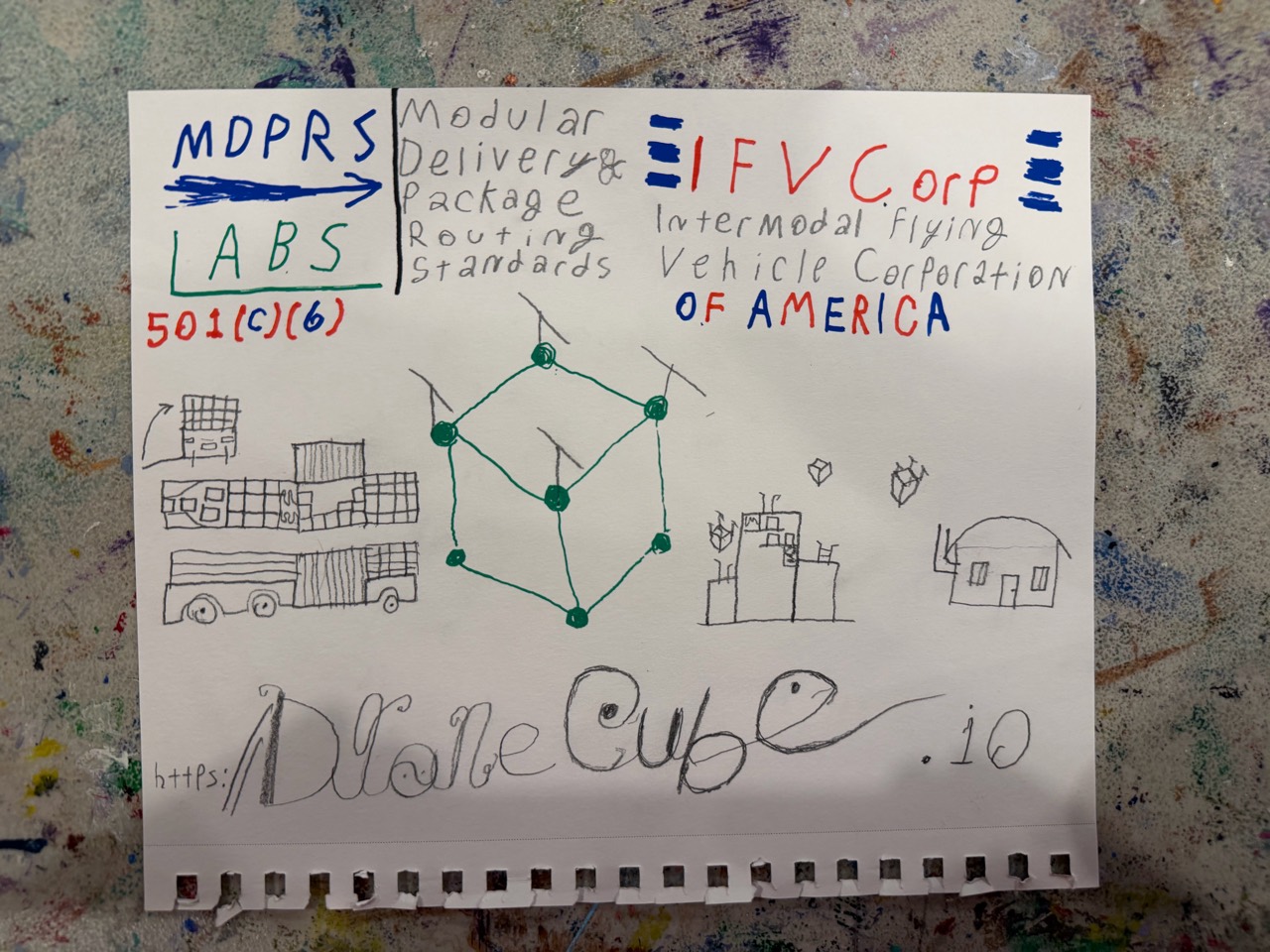
08 / A FEW GOOD QUESTIONS
The cube is the common cargo unit and interface at the center of the concept. A drone is one compatible carrier. The sketch also imagines factories, ground transit, and homes using the same standard.
No. Routing should select compatible modes for the payload and destination. Some journeys could remain entirely on the ground; others could combine ground transport with a short flight.
A common interface across different systems: defined geometry, supported payload profiles, routing identity, and a verifiable handoff. It does not mean all vehicles are identical or that all cargo fits one size.
This is a concept site derived from the founding sketch. Technical dimensions, hardware, certification, and operating procedures still need engineering and validation. The downloadable notes describe the vision, not a production specification.
The proposed system keeps cargo retained by its current custodian until the next receiver confirms secure attachment and acceptance. A failed transfer needs an explicit recovery state and a human-assisted path before the journey continues.
ONE CUBE. MANY POSSIBILITIES.